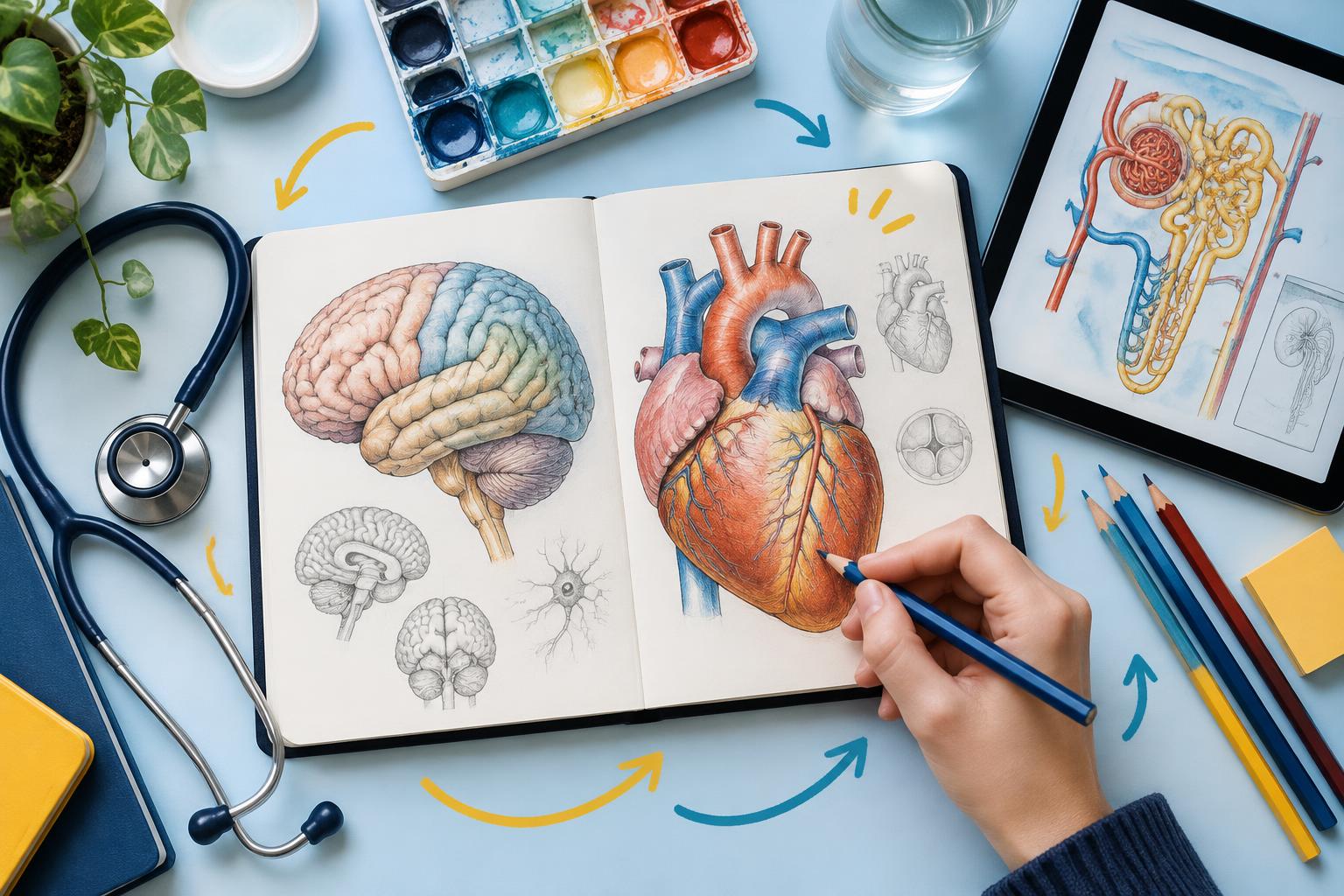
Most pre-meds think of drawing as a hobby, separate from the "serious" work of getting into medical school. For me, it turned out to be one of my biggest advantages, and here are five ways it helped me as a pre-med and how you can use it too on your pre-med journey.
1. Studying for Pre-Med Classes
It's well documented that visual representations, like drawings, aid memory: people tend to remember images more easily and accurately than words alone. But visuals go a step further when you do it yourself. Just as taking notes turns passive listening into active, deep processing, so too drawing turns studying into something active.
In college, I used drawing when taking notes for all of my classes. I became known for my amazing drawings, so much so, that classmates would ask to borrow my notes because of my pictures. The funny thing is, teaching others with my drawings helped me learn the material even better.
Even if you're not very good, it doesn't matter — even doodles can be helpful. Take a crack at drawing whenever something is hard to understand. And don't assume drawing only helps in biology or anatomy, visuals can also help in classes like chemistry, physics, and biochemistry.
2. Shadowing
As a pre-med, it's hard to offer real value in a clinic while you're still learning the basics. However, drawing is a concrete skill you can offer to be able to contribute right away. It gives you a reason to be in the room before your medical knowledge has caught up — it's a skill not many people have, but lots of people want.
The doctors I shadowed loved that I could draw, and they'd often let me draw out pathologies for patients, thinking it might help with patient understanding. Little did they know, those drawings also helped me with my understanding, as well.
Don't be shy about telling doctors that you can draw when shadowing. Doctors generally love it when pre-meds can draw. Build a small portfolio of three to five science or medical drawings to share when you reach out. When you email a doctor, offer something specific, like "I can use drawings to help with patient communication and education," instead of just asking to shadow.
3. Research and Internships
Research depends on clear communication, and much of it happens through figures. An original illustration can explain a method, model, or finding faster than a paragraph of text. Drawing skills are very valuable in research.
Drawing has opened many doors for me, and the first big one came after my freshman year of college. I was accepted into a summer internship normally reserved for upperclassmen and graduate students, mainly because I had advanced art skills — I spent the summer creating a piece of art portraying communication between the brain and the eyes. That internship was a big boost to my resume and opened up other doors for me that were helpful along my journey.
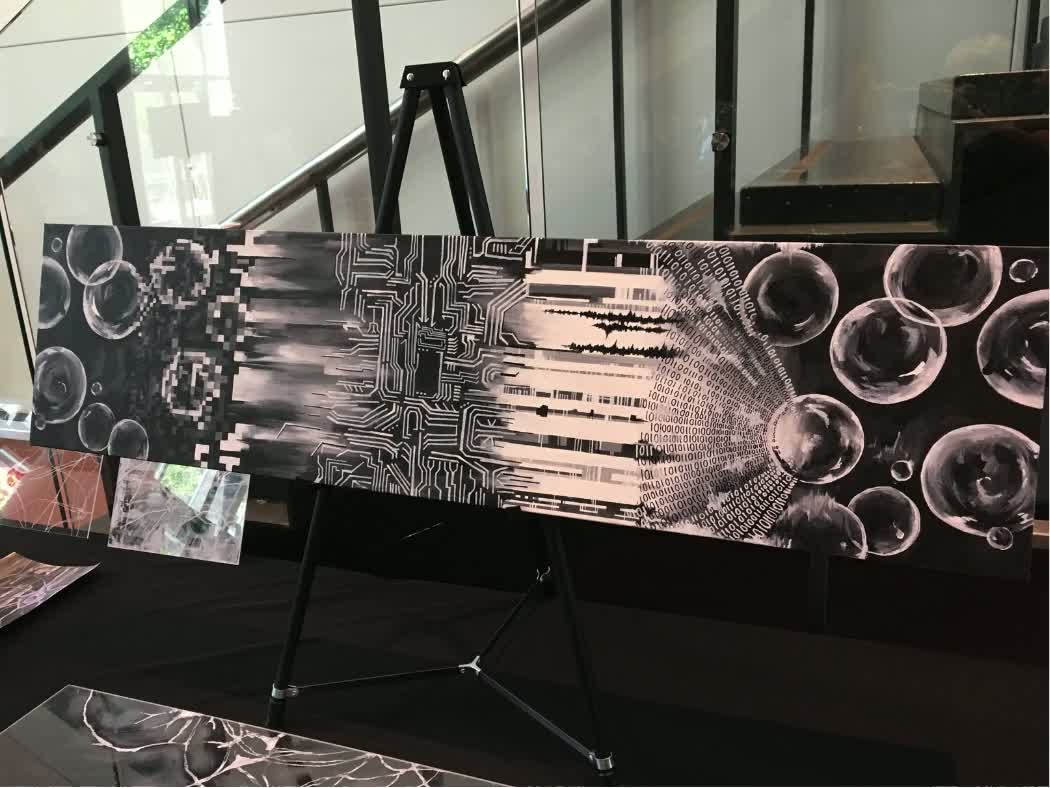
Always offer to draft schematics or illustrations for your lab's posters, presentations, or manuscripts. Ask whether your figures can be credited to you, since that gives you a tangible contribution to point to on your CV and in interviews. Don't be shy about telling your PI, or the head of the lab, that you can draw.
4. MCAT Prep
The MCAT covers an enormous amount of content, and much of it, like biochemical pathways, physiology, and experimental setups, is easier to grasp visually. Drawing forces you to organize information and see how the pieces connect, and it's a fast way to work through tough passages on test day.
Unfortunately, this is the section where I can help the least, because I never took the MCAT — I never had to! I was accepted into an early acceptance program for medical school. So I guess one could say my artistic ability did end up helping me with the MCAT.
Build a set of one-page diagrams for high-yield topics like glycolysis, the Krebs cycle, and the nephron, and redraw them from memory each week. Practice sketching quick diagrams as you work through practice passages. And whenever you're struggling to remember something, try drawing it out!
5. Standing Out
Medical schools see thousands of applicants with strong grades and similar activities. A distinctive skill tied to medicine gives admissions committees something to remember you by. Drawing also signals qualities schools value, like observation, communication, and creativity, and it shows you care enough about patients to learn a new skill.
As I just mentioned previously, my artistic ability really helped me stand out as a medical school candidate; it was one of the things that made me unique. I leaned heavily into my art as a pre-med, and I think it was one of the main reasons I was accepted into medical school as a sophomore.
Don't list drawing as just a hobby; connect it to how you learn, contribute, and communicate. Keep a running record of where your drawings were used, such as research, study guides, or patient handouts, so you have concrete examples ready. When the time comes, tell a specific story about a moment when one of your drawings helped someone understand something.
At Draw Medicine, we teach pre-meds to draw for patient education, a skill most people assume only matters once you're a clinician. But you don't have to wait until med school for it to pay off: as an undergrad, drawing can already help you learn, contribute, and stand out.