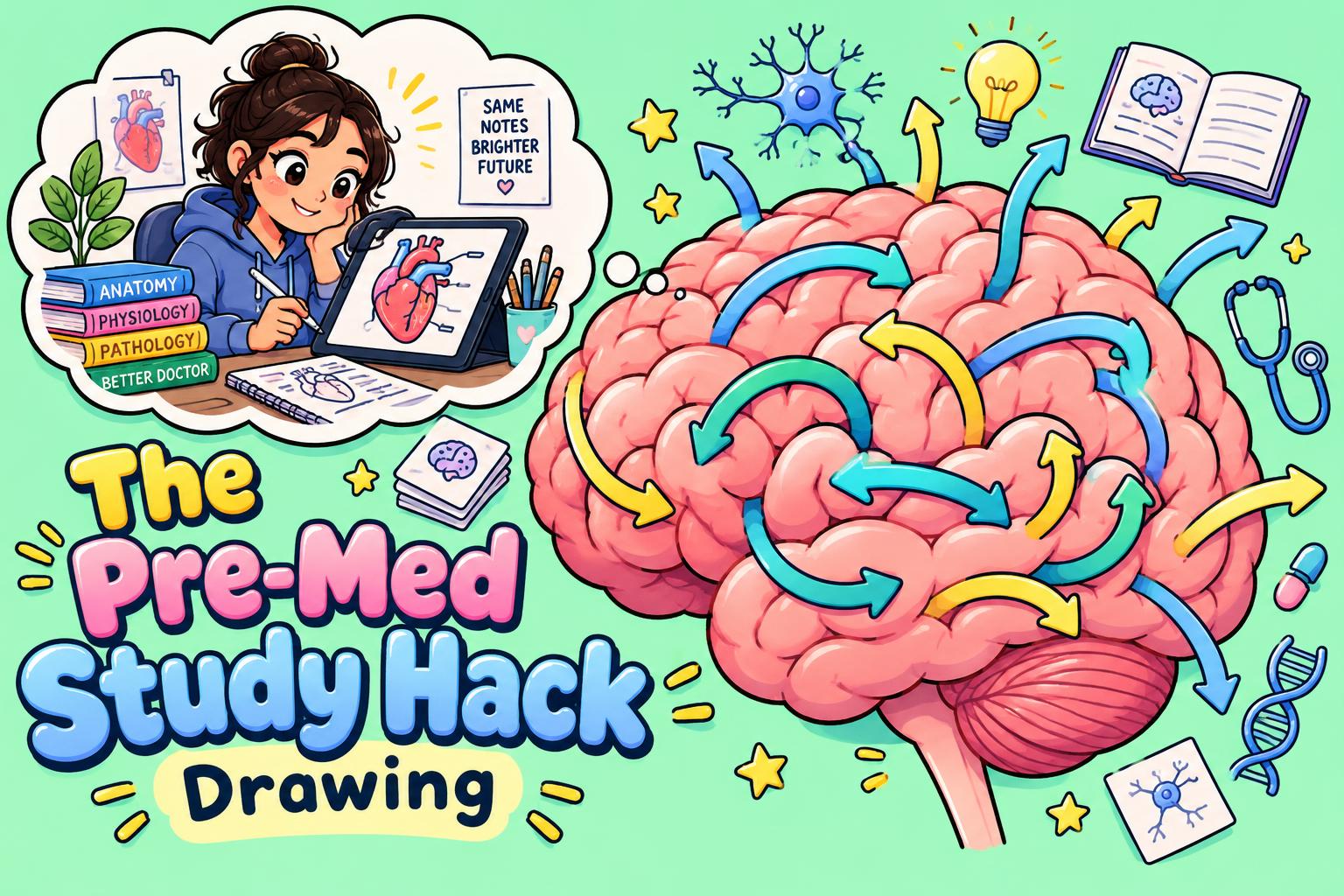
Most pre-meds study by reading, highlighting, and rereading. But a growing body of research suggests that picking up a pen and drawing what you're learning can help it stick far better.
Here are five science-backed reasons why drawing works as a study tool and how it could help you with your memory recall.
1. Visual Memory — Your brain remembers pictures better than words
Research published in Frontiers in Psychology has found that visual representations, like drawings, can aid memory recall. In general, we remember visual information more easily and more accurately than the same information delivered as text.
Think about how much you're asked to memorize as a pre-med. Turning even a few of those pages of text into images gives your brain a format it's naturally better at holding onto.
2. Dual Coding Theory — two channels beat one
Dual coding theory suggests that pairing visual and verbal information strengthens memory. Studies have shown that people who both draw and write, or sketch a concept and then describe it, tend to retain more than people who use only one mode.
In practice, that can look like a diagram with short labels and a sentence or two explaining what's happening. The drawing gives you the big picture, and the words pin down the details.
3. Mind Mapping — giving your knowledge a structure
Mind mapping means visually organizing ideas and connecting them through drawings or diagrams. It has been shown to improve memory and recall because it forces you to structure what you know, not just collect it.
This matters in medicine, where almost nothing exists in isolation. A drug connects to a receptor, which connects to a pathway, which connects to a disease. Mapping those links on paper makes the relationships visible, and relationships are easier to remember than a list of disconnected facts.
4. Kinesthetic Memory — Your hand remembers too
Drawing is a physical act. It uses fine motor skills and hand-eye coordination, and that brings kinesthetic memory, our memory for movements and physical actions, into the mix.
When you trace the path of blood through the heart with your pen, you aren't just reading about it. You're doing it, and that motion gives your brain one more way to find the information later.
5. The Generation Effect — Making it beats reading it
The generation effect is the finding that we remember information better when we actively produce it ourselves. Drawing is generation by definition: you have to decide what to include, where it goes, and how the pieces fit.
Rereading a textbook page is passive. Redrawing that page from scratch makes you work out what you actually understand, and that effort may be what makes it stick.
You don't have to be an artist
None of these benefits depend on your drawings being beautiful. Stick figures, boxes and arrows, and rough sketches all count. What matters is that you're turning information into something visual, with your own hands, in your own way.
That idea is a big part of why we created Draw Medicine. If you want to try it, start small: next time you study, close the book and sketch what you just read. You might be surprised how much stays with you.